

When a tenancy ends, letting agents have more to manage than simply arranging a check-out. Meter readings need to be recorded, suppliers need to be notified and responsibility for the property may need to be established during any void period.
For one property, this process is relatively straightforward. For agencies managing hundreds or thousands of properties, manually completing the same steps across different suppliers can quickly become a significant administrative task.
This guide explains how utility registrations work when a tenant moves out, what information letting agents need, how to notify suppliers manually and how agencies can streamline the process.
Jump to
- What happens to utilities when a tenant moves out?
- Why is registering utilities important?
- Who is responsible when a tenant moves out?
- How to manually register a utility registration.
- How to find who supplies for a property.
- Manual vs Automated referrals
- How Notify automates utility registrations
- CRM integrations make the process even easier.
- Simplify your utility registrations with Notify
What happens to utilities when a tenant moves out?
When a tenant moves in or out, someone needs to notify the relevant providers that are responsible for the property has changed. This includes:
Energy
Water
Council Tax
These processes can vary on the property type, the supplier and what is stated in the tenancy agreement.
Why is registering utilities important?
Submitting accurate utilities will ensure:
- Outgoing tenants receive accurate final bills.
- Landlords aren't incorrectly billed during tenancy changes.
- Utility accounts are transferred correctly during void periods.
- New tenants know who currently supplies the property.
- Letting agencies have a clear autit trail of every tenancy change.
Without notifying suppliers promptly, billing errors and disputes can occurs and valuable time is spent chasing suppliers to correct mistakes.
Who is responsible for utilities when a tenant moves out?
Responsibilities of utilities can vary depending on the scenario and the tenancy agreement.
| During the tenancy | The tenant may be responsible for their own household utility accounts depending on the tenancy arrangements. |
| At the end of the tenancy | The outgoing tenant’s responsibility needs to be brought to an end with the relevant providers. |
| During a void period | Responsibility may fall to the landlord or another party depending on the circumstances and agreements in place. |
| When a new tenant moves in | The incoming tenant’s occupancy needs to be recorded with the relevant providers. |
How to manually register a utility registration
Below we have written step-by-step how to manually register tenant utilities with helpful tools and tips to do this effectively.
1. Receive notice that the tenancy is ending
Once a tenant provides their move-out notice the process can begin. At this stage you'll typically:
-
-
Confirm the agreed move-out date.
-
Arrange for a check-out inspection.
-
-
-
Check whether a new tenancy is already agreed.
-
Establish whether a void period is expected
-
Managing this stage effectively helps reduce disputes along the way and keep landlords informed through out the process. Want to find out how to handle void periods effectively? Read the blog post below 👇
-1.png?width=1244&height=314&name=Submit%20let%20only%20properti%20(2)-1.png)
(https://oneutilitybill.co/our-insights-b2b/avoiding-void-period-disputes)
2. Take a final meter reading
Accurate meter readings can help make sure the liable parties are billed correctly for their energy use. you will need to record and file:
-
- ⚡ Electricity meter readings
- 🔥 Gas meter readings (where applicable)
- 💧 Water meter readings (if the property is metered)
You should Phot
Find out more on how to submit meter readings here: https://oneutilitybill.co/our-insights-b2b/avoid-utility-disputes-with-meter-readings
.png?width=1246&height=282&name=Submit%20let%20only%20properti%20(3).png)
3. Gather the tenancy information
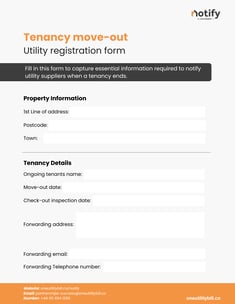
Before contacting the suppliers you’ll need to collect all of the relevant tenancy information. We recommend having this on one document so its easier to find all needed information quickly. This typical includes:
-
- Property address
- Outgoing tenant name
- Tenancy end date
- Date of final meter reading
- Electricity meter reading
- Gas meter reading
- Water meter reading
- Meter photographs
- Forwarding address, where available
- Landlord/property management details
- Expected void period, where applicable
Having all of this information ready helps avoid delays when notifying your suppliers. If your agency uses a CRM system you will usually find most of this information there.
To make utility registrations easier, we’ve created a free downloadable form that helps you capture all the information you need during a tenant move-out. Simply click ‘Download’ to save the form and start using it for your tenancy registrations.
4. Notify each supplier
Once all information has been collected and stored its time to contact each supplier individually.
Depending on the supplier this usually involves
-
-
Completing an online form
-
Sending an email
-
Calling their customer service team
-
If there’s a void period before the next tenancy begins, responsibility for utility accounts is usually transferred to either the landlord or the managing letting agent until a new tenant moves in.
While the process isn’t particularly difficult, repeating it across multiple suppliers for every tenancy quickly becomes extremely time-consuming.
How to find who supplies a property?
To check which utility providers and councils currently supply for your properties you can check the postcode checkers below:
-
Energy : https://www.ofgem.gov.uk/finding-your-energy-supplier-or-network-operator
-
Water: https://www.water.org.uk/customers/find-your-supplier
Supplier information should be checked for each property rather than relying on information from a previous tenancy, as circumstances can change.
What happens after you notify a supplier
After you have notified all relevant suppliers of tenancy changes, you should still keep record of the following:
- When the notification was submitted
- Which supplier was contacted
- How it was submitted
- Any reference numbers provided for the notifications
- Received confirmation that the supplier has been informed
- Outstanding supplier queries
- Date the registration was complete
Manual vs Automated referrals
For agencies managing a growing portfolio, manual utility registrations can become a significant drain on resources. Automating the process through registration services could save the agency a lot of time and keep everything in one place.
|
Manual process |
Automated process |
|---|---|
|
Agent gathers tenancy information |
Information can be transferred automatically |
|
Agent identifies suppliers |
Relevant suppliers can be identified as part of the process |
|
Agent contacts suppliers individually |
Notifications are handled on the agent’s behalf |
|
Agent follows up outstanding queries |
Queries can be managed centrally |
|
Agent records progress |
Progress can be tracked through a portal |
|
Agent maintains records |
Notifications provide a central audit trail |
How Notify automates utility registrations
Notify removes the manual administration from the utility registration process, allowing letting agents to manage tenancy changes far more efficiently.
We contact the suppliers for you ☎️
Our experienced operations team notifies the relevant utility suppliers on your behalf.
Thanks to our established supplier relationships, we’re able to manage the process efficiently without your team needing to spend hours contacting multiple organisations.
We handle supplier queries 💭
If additional information is required or a supplier identifies an issue, our team works directly with them to resolve it.
That means fewer phone calls, fewer emails and less administration for your agency.
Track every notification
The Notify portal provides complete visibility throughout the process.
You’ll be able to see exactly where every utility notification is, whether it’s:
- Submitted
- In progress
- Awaiting supplier action
- Completed
No more wondering whether a supplier has been contacted.
CRM integrations make the process even easier
If your agency integrates its CRM with Notify, tenancy information is automatically transferred into the platform.
This significantly reduces manual data entry and, in many cases, means agents don’t need to do anything beyond progressing the tenancy as normal.
Automation removes repetitive administration while improving accuracy across every submission.
Simplify your utility registrations with Notify
Utility registrations are an essential part of every tenancy change, but they don’t have to consume valuable time.
By automating the process with Notify, letting agencies can reduce administration, minimise billing disputes, improve visibility across every tenancy and even generate additional commission, all while delivering a smoother experience for landlords and tenants.
Ready to spend less time on admin and more time growing your agency?
Book a free demo today and discover how Notify can transform your tenancy notification process.