

Quick links:
- Using Royal Mail redirection to avoid missing letters
- Which addresses do I need to update when I move?
- How much does it cost to redirect my post?
- Why you shouldn’t rely on ‘free’ mail redirection in the UK
- What mail can and can’t be redirected?
- Reducing moving hassles with One Utility Bill
When you move house, making sure your post follows you can save time, hassle and stress down the line. Updating your address can take time, but missing bills, medical appointments or even risking identity theft is far worse in the long run!
It’s up to you to let people know you have a new address, but moving house comes with a long enough to-do list as it is, you’re bound to forget some, and people may forget even if you let them know. To be safe, you can set up a postal redirect.
In this guide, you’ll learn what this service is and why it might be a good idea for movers with busy lives…
The Royal Mail’s redirect service will spot any letters addressed to you at your old address and redirect them to your new one.
Important note: Having your post redirected doesn’t update the sender about your new address. You’ll still need to let them know. It just means you won’t miss letters from anyone you’ve forgotten to update. It’s ideal for keeping you safe in the first few months after your move.
Redirection durations explained
You select a redirect duration when setting up the service (more on that below). This can be:
- 3 months: The cheapest option is ideal for covering your back for a short time but are confident all important organisations have your new address.
- 6 months: A mid-range option that gives you more peace of mind for delayed letters or people/companies that contact you less frequently.
- 12 months: This covers redirects for a full year after you move and is recommended by the UK’s fraud reporting centre, Action Fraud.
How to set up a redirect
Setting up a redirect is simple, but the process can take up to five working days. The faster you register, the less likely you will miss important mail. In the ultimate guide to moving home, the redirect is recommended at least two weeks before your move.
To sort your redirect, either register online, by post or in person at a Post Office branch:
📱Register online
- Visit he Royal Mail redirection page to register online.
- Click ‘Get a quote’
- Select your move date and a start date for the redirection.
- Decide how long you want to redirect your mail.
- Continue with your quote if you’re happy with the proposed price.
- Fill out your personal details to finalise the process:
- Give names and dates of birth for anyone who needs the redirect (you and anyone else who lives with you).
- Your new and old address and postcode
- A valid debit or credit card issued in the UK and registered to your old or new address
- You’ll also need to provide valid proof of identity.
- Submit your payment to complete your redirect setup.
- It takes five days for Royal Mail to process a redirect, so register in plenty of time.
✉️ Register by post
- Download and print the application form.
- Add your old and new addresses and the personal details of everyone who needs the redirect
- Choose your preferred redirect duration.
- The form allows you to specify a start and end date.
- Finalise the form and sign it.
- Provide valid proof of identity.
- Send your completed form and identification to Cooper House, Lakeside, Festival Way, STOKE ON TRENT, ST1 5RY.
✍️ Register in person
- Find a valid Post Office branch using the branch finder tool.
- Visit the branch and tell them you want to set up a redirect.
- Fill out the same form as above for a postal application in the branch.
- Having staff on hand to help out is one benefit of doing it at the Post Office.
- Post Office staff will also check your proof of identity, so you won’t need to send it away.
Proof of identity for redirection
When setting up your redirection, you have to provide two forms of identification. If you want someone else included in the redirection and they don’t share your last name, you’ll need to provide separate proof of ID for them.
Royal Mail asks for a ‘Proof of identity’ and ‘Proof of old address’. These can be any of the following:
Proof of identity:
- Current passport
- Driving license
- Credit/debit card
- Bank/building society book
- Birth certificate (under 16s only)
- EU state member identity card
Proof of old address:
- Original utility bill
- Original credit card statement
- Original mortgage statement
- Original bank or building society statement
Don’t worry if you’ve gone paperless and don’t have any of these statements to hand. Most utility suppliers and banks have the option to print/download a statement with your address. If not, you can get in touch and ask for something to be sent to you.
The Ultimate Moving guide has a full list for you, but here are the essential addresses to change when you move:
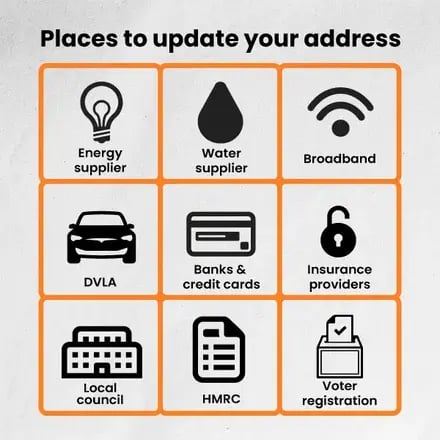
- Energy supplier
- You’ll need to let them know you’re moving AND make sure you remember to send final readings on moving day.
- Water supplier
- Broadband
- Broadband setup can take time, so make sure you do this in plenty of time in case you need an engineer appointment!
- DVLA
- Let them know to change your VSC logbook and driver’s licence.
- Banks and credit cards
- Ideally you’d let your bank(s) know at least 14 days before your move.
- This is one of the most important ways to avoid identity theft.
- Insurance providers
- If you’ve already sorted building and contents insurance for your new place, make sure to end the policy for your current home, and update your address for any future post.
- Local council
- Let local authorities for both homes know that you’re moving so you’re paying the right amount of council tax.
- Find the local council of your new address to make this easier.
- HMRC
- If you’re self-employed or receive certain benefits, let HMRC know your circumstances have changed!
- Voter registration
- Get registered to vote at your new address so you don’t miss a vote
Check out the full list (and places it’s easy to forget…) at our moving guide.
Costs for Royal Mail’s redirection services differ depending on whether you’re an individual or a business. Businesses pay a lot more, but your price will fluctuate depending on how long you want the redirect to last and whether you’re moving abroad.
Here’s a quick breakdown of the costs:
Personal Redirects Within The UK
Note that the ‘additional person’ charge will be added for every adult in the household. For example, a redirect covering three adults in one household for three months would cost £61.50.
|
Duration |
Lead Applicant |
Additional Person |
|
Up to 3 months |
£41.50 |
£10.00 |
|
Up to 6 months |
£61.00 |
£11.50 |
|
Up to 12 months |
£87.00 |
£12.50 |
Personal Redirects To Overseas Addresses
|
Duration |
Lead Applicant |
Additional Person |
|
Up to 3 months |
£154.00 |
£29.00 |
|
Up to 6 months |
£219.00 |
£32.00 |
|
Up to 12 months |
£313.50 |
£34.50 |
Concessionary rates
You might be eligible for concessionary rates if you’re on Universal or Pension Credit. These discounted rates don’t apply to overseas redirects.
For a single adult household:
|
Duration |
Standard Price |
Concessionary Price |
|
Up to 3 months |
£41.50 |
£22.50 |
|
Up to 6 months |
£61.00 |
£31.00 |
|
Up to 12 months |
£87.00 |
£62.00 |
The concessionary rate works differently from the standard rate and doesn’t increase based on every additional adult. Instead, prices are capped based on household size, as detailed on the Royal Mail concessions page.
Business redirects
Businesses pay much higher rates than personal customers. If you run a business from home and need to set up a redirect, expect to pay the following:
|
Duration |
Standard Price |
|
Up to 3 months |
£274.50 |
|
Up to 6 months |
£403.00 |
|
Up to 12 months |
£649.00 |
Can I pay monthly?
It’s not possible to spread the cost, unfortunately. Royal Mail asks for full, upfront payment for the entire redirection period. There’s no option to pay monthly.
Given the risk of identity theft or missing important letters, setting up a redirect is an essential step. If you’re tempted to avoid the Royal Mail fee and find a free alternative, be aware there’s no real replacement for the official service.
Instead, you might find some free ‘change of address’ services. These services notify partnered providers, such as banks, utility companies, and insurers, that you’ve changed your address.
They don’t actually redirect mail, so any letters sent with your old address will still go there, and you won’t know anything about it. Royal Mail, on the other hand, makes sure that letters from ALL senders (not just those partnered with the ‘change of address’ service) are intercepted and sent to your new address.
If you want all your mail to reach you, you’ll need Royal Mail’s redirection service. Once your post arrives, don’t forget to update your address with each sender so future mail comes straight to your new home.
It’s not worth diving into the complete list of what can and can’t be redirected in this guide. Instead, all UK movers need to know is that most letters and parcels sent via Royal Mail services can be redirected to their new home. Parcels sent from other couriers, such as Amazon or Evri, can’t be redirected.
If you’re moving overseas, Royal Mail won’t redirect any parcels over 25 mm thick, weighing more than 100g, or that appear to contain goods.
Redirecting your post is just one thing on the long list of stuff to do when you're moving home. If you want to take something else off the list, you can avoid dealing with bills setup with a One Utility Bill package.
Choose the utilities you want to bundle into a package (including Unlimited Energy options…) and add your payment details. The team will handle all of the setup with suppliers for you, and your finances will be simpler ‘cause all of your utilities will come out in one easy monthly payment. That’s energy, water, broadband, TV licence and TV package all in one, with your choice of services!