

Quick links:
- How to find a house share
- What to check before you sign
- How to split the bills and other expenses
- House share etiquette: keeping shared spaces happy
- How to communicate with your housemates
When you share a house or flat, you’ll need to agree on a fair way to split living costs, pay household bills and share other responsibilities like cleaning and food shopping.
A little organisation when you move in can make house sharing a lot less stressful. In this guide, we'll cover some of the most common house share problems and practical ways to avoid them, including how to split bills fairly.
You can also make splitting your bills easier with a One Utility Bill bills package, so you can each have your own monthly direct debit covering all of your bills.
You might already have a place sorted, but if not, here are some things to consider before you sign a tenancy agreement.
Start by checking house share websites and noticeboards for a room or property that suits your needs. You’ll find good options on SpareRoom, Ideal Flatmate and Rightmove.
When you find somewhere you like, try to meet the people you'll be living with and view the property before agreeing to anything.
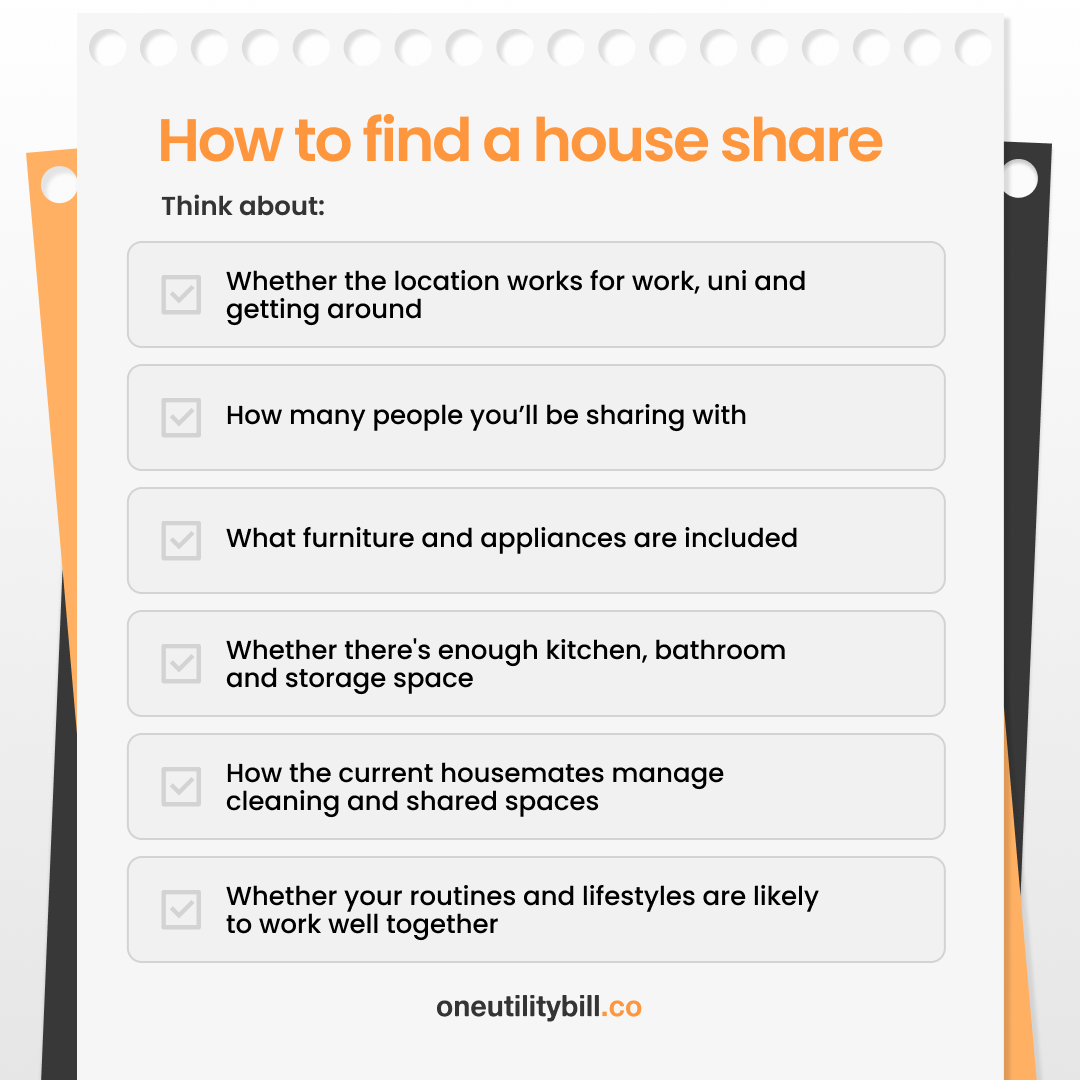
If the house feels like a good fit, the next step is checking exactly what you're agreeing to before you sign.
Before you sign a tenancy agreement, make sure you understand what you're agreeing to, particularly when it comes to rent and household bills.
In a house share, you'll usually have one of two types of tenancy:
- A joint tenancy: Everyone signs the same tenancy agreement and shares responsibility for the property.
- Separate tenancies: Each housemate has their own tenancy agreement, usually for their individual room.
With a joint tenancy, you can be liable for the whole rent, not just the amount you've agreed to pay between yourselves. If one housemate doesn't pay their share, the others may have to cover it.
With separate tenancies, you're usually only responsible for the rent set out in your own agreement.
Your pre-signing checklist
Before you sign, check:
- Your tenancy type: Is it a joint tenancy or do you have a separate agreement?
- The rent: How much is it, when is it due and what does it include?
- Household bills: Check which bills you need to pay when renting, how much they usually cost and whether any are included in your rent.
- The deposit: How much do you need to pay and how will it be protected?
- Leaving the tenancy: Check the notice period, whether there's a break clause and what happens if one housemate wants to leave early.
Rules around renting vary across the UK, so check the guidance that applies where you live if you're unsure about your rights or responsibilities.
It's also worth agreeing with your housemates how you'll handle shared costs, damage and someone moving out while everyone else stays. Writing this down can help avoid disagreements later, but remember that an agreement between housemates doesn't replace your tenancy agreement.
Sharing household costs is one of the benefits of living with housemates, but it helps to agree how you'll manage them from the start.
Our guide to how to split the bills covers this in more detail, but here are a few things to consider:
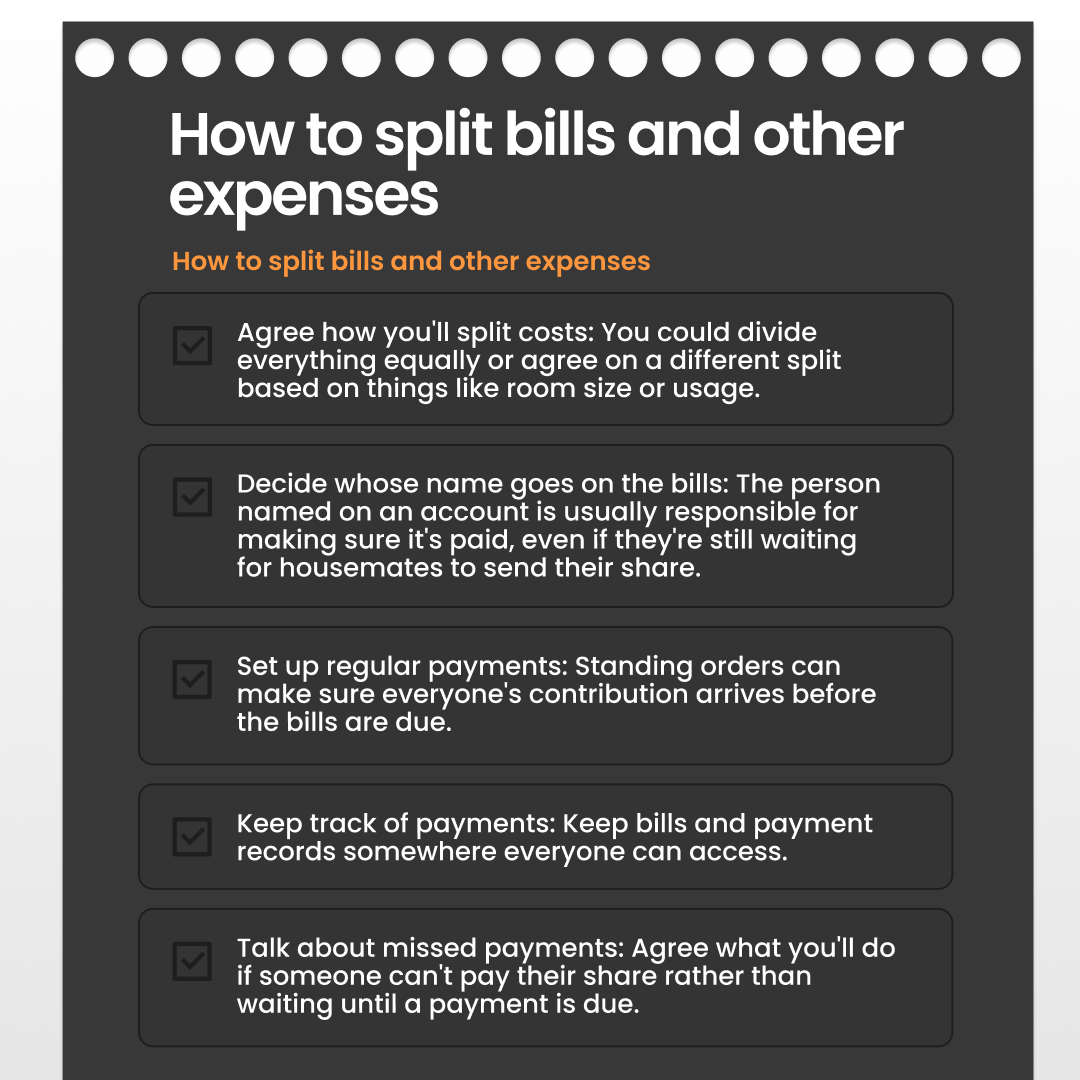
Some landlords and letting agents include certain household bills in the rent, so check your tenancy agreement before setting anything up.
If you'd rather not manage several different accounts and payments, you can combine your house share bills into one monthly payment, with Unlimited Energy available if it suits your household.
You don't need to have the same habits as your housemates, but it helps to agree on a few basics. Disagreements can be caused by anything from cleaning to noise, guests and the use of shared spaces. Everyone probably has different expectations, so be clear from the start rather than waiting until something becomes a problem.
For cleaning, agree on what everyone considers a reasonable standard and how you'll share the work. A simple cleaning rota can help. Keep a cleaning rota on the fridge or in another shared space, with specific jobs and how often they need doing.
Here are some things to think about for each room:
🍽️ Kitchen
The kitchen is one of the busiest shared spaces, so agree on a few ground rules:
- Make sure everyone has enough cupboard, fridge and freezer space.
- Decide which food and household essentials you'll share and how you'll split the cost.
- Agree how quickly dishes should be washed and surfaces cleaned after cooking.
- Let housemates know if you're going to need the kitchen for a long time, such as for meal prep.
🛁 Bathroom
If everyone needs access to the bathroom at a similar time, a little planning can make mornings much easier:
- Work around housemates who need to leave for work or university at a particular time.
- Be considerate about how long you spend in the shower, particularly at busy times. Our short power shower guide has tips for cutting shower time and water use.
- Make sure everyone has space for toiletries, or keep some products in your bedroom if storage is limited.
- Leave the bathroom clean and tidy for the next person.
🛋️ Living room and other shared spaces
Communal areas should feel comfortable for everyone who lives there.
Avoid letting personal belongings take over shared spaces and agree how you'll use things like the TV, storage and shared furniture. If someone regularly works or studies in a communal room, talk about when other housemates need to use the space too.
🛏️ Bedrooms, noise and guests
Your bedroom might be your own space, but noise can easily travel around a shared home.
Agree on reasonable quiet times, particularly if people work different hours, and keep music, TV and late-night noise at a level that isn't likely to disturb other people.
It's also worth agreeing some basics around guests, including how often people can stay over and whether you'd like a heads-up before someone visits.
Even the best housemates won't agree on everything. Talking about small problems early can help stop them turning into bigger disagreements.
A group chat is useful for everyday things like reminding someone about the bins, letting everyone know you're having people over or checking who's bought the washing-up liquid. It’s easy for texts to get lost or forgotten, so It’s also handy to have physical messages somewhere like the fridge or a central noticeboard where everybody will see it.
For anything more complicated, particularly disagreements about bills or shared responsibilities, try to talk about it in person. Be clear about what's bothering you, listen to everyone involved and focus on finding a solution that works for the household.
It's particularly important to keep talking about money. Make sure everyone knows what they owe, when payments are due and what to do if someone is struggling to pay their share.
Make house share bills simpler
Living with other people comes with plenty of things to organise. Your household bills don't have to be one of them.
With a One Utility Bill package, you can combine household bills like energy, water, broadband and TV into one monthly payment. Each housemate can pay their share directly, so one person doesn't have to collect the money or manage several different accounts.
You can also choose Unlimited Energy, giving your household a fixed monthly energy payment based on your property and household.
Get a quote to make bills easier for your new place!